



By Ma He, Foresight News
At around 9 PM on March 10, the 20 millionth Bitcoin was mined. This means 95.2% of the total 21 million BTC supply has been mined, leaving only 1 million to be mined over the next 114 years.
On January 3, 2009, Satoshi Nakamoto mined the Genesis Block (also known as Block 0) of the Bitcoin network, marking the official launch of the Bitcoin blockchain. Seventeen years have passed since then.
Over this long journey, BTC has risen from $0.06 to $126,000 in 2025, evolving from a geek's toy into a massive crypto asset once boasting a market cap exceeding $2.5 trillion, demonstrating its robust vitality to the world.
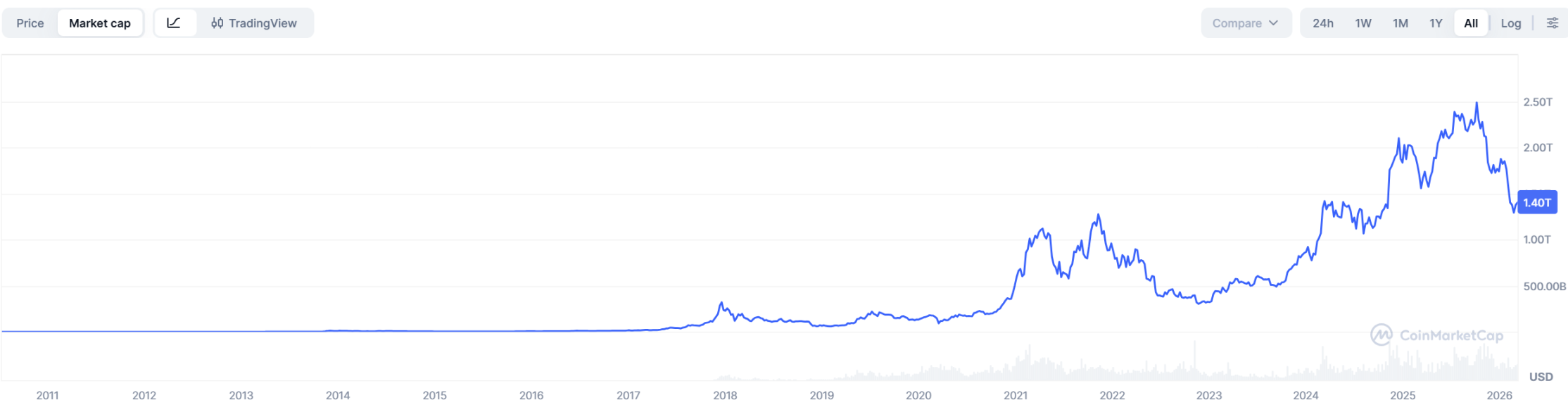
Setting aside the staggering return multiples, there are still some noteworthy data points in Bitcoin's development history.
The chart's horizontal axis spans from 2010 to 2026, with each bar corresponding to a specific metric, labeled with the number of days required from left to right. The shortest is "Transfer volume exceeding 20 million BTC," taking only 729 days, roughly corresponding to early 2011. At that time, Bitcoin was still in its early stages with a low price, but significant liquidity accumulation was already evident on-chain.
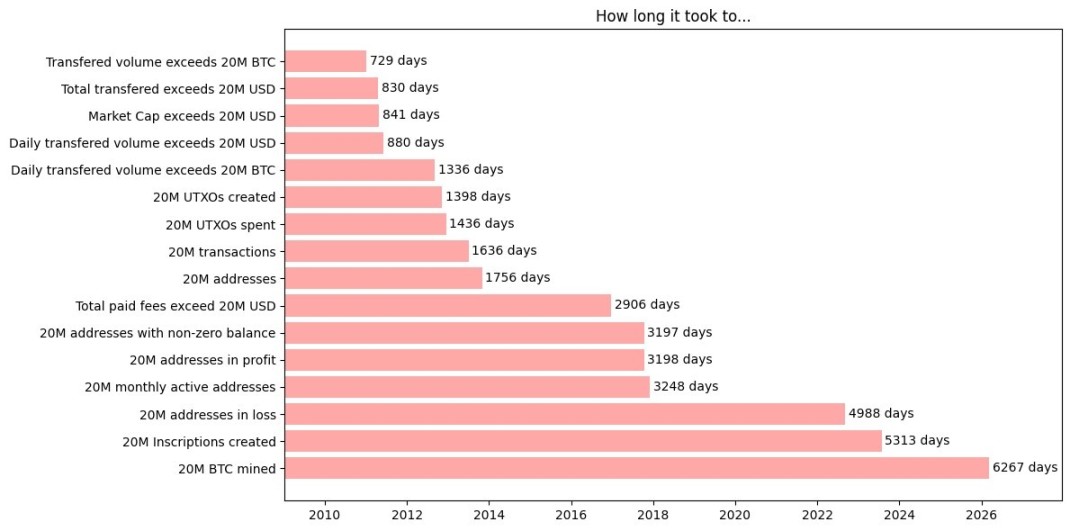
Subsequently, it took 830 days for BTC's total transfer value to exceed $20 million, 841 days for its market cap to surpass $20 million, and 880 days for daily transfer volume to exceed $20 million. These early metrics marked Bitcoin's transition from an experimental protocol to an asset form with practical value.
Over time, the duration required for on-chain activity metrics gradually lengthened. It took 1336 days for daily transfer volume to exceed 20 million BTC, 1398 days to create 20 million UTXOs, 1436 days to spend 20 million UTXOs, 1636 days for Bitcoin to accumulate 20 million transactions, and approximately 1756 days to have 20 million addresses.
Most of these data points cluster around 2013-2014, following Bitcoin's first halving (November 2012, block reward reduced from 50 BTC to 25 BTC), when the network ecosystem began its substantive expansion phase.
It took 2906 days, nearly 8 years, for BTC's total paid fees to exceed $20 million, reflecting the extremely low transaction fees in the early days, which only accumulated as network demand rose and congestion increased. Bitcoin's 20 million non-zero balance addresses, 20 million addresses in profit, and 20 million monthly active addresses were achieved in 3197 days, 3198 days, and 3248 days respectively, roughly corresponding to the 2017 bull market. During this period, Bitcoin gradually entered the public consciousness, and the number of holding addresses grew significantly.
The longest bar corresponds to "20 million BTC mined," taking a total of 6267 days, approximately 17 years and 2 months.
Bitcoin has a total supply cap of 21 million coins, issued through block rewards, which halve every 210,000 blocks (approximately every 4 years). The initial reward was 50 BTC per block, halved to 25 BTC, then to 6.25 BTC per block after the 2020 halving, totaling approximately 19,687,500 coins mined by then; the fourth halving in April 2024 reduced it to 3.125 BTC per block, the current cycle. Each halving cuts the new coin issuance rate in half, enhancing the asset's scarcity and correlating with price cycles.
The estimated time to mine the remaining approximately 1 million BTC, based on the current block reward and halving schedule, is about 114 years. The current reward is 3.125 BTC per block, adding about 164,000 new coins annually; after the 2028 halving, it will drop to 1.5625 BTC per block, continuing to decrease thereafter. In the final stages, issuance will proceed slowly in satoshis until completion around 2140.
This is the core logic of Bitcoin's design: rapid distribution in the early stages to establish a foundation, followed by an extremely low rate to reinforce its "digital gold" properties. Future miner revenue will increasingly rely on transaction fees to maintain network security.
The 20 million milestone is not an endpoint but the starting point of a new phase. As the remaining supply is slowly released, Bitcoin's digital gold narrative will be further strengthened.

