



Written by: Cointelegraph
Compiled by: AididiaoJP, Foresight News
Key Points:
- Bitcoin often surges by 20% following a spike in oil prices, though the initial market reaction is typically chaotic and unpredictable.
- Bitcoin's current trend closely mirrors that of tech stocks, showing an 81% correlation with the Nasdaq 100 index, making it less sensitive to oil price fluctuations.
On Sunday, oil prices soared to $101 per barrel, a staggering 55% surge in 10 days, setting a historical record. This event drove the S&P 500 index to a 10-week low last Friday. Bitcoin initially saw a rally, gaining 16% from February 28th to this Wednesday, but by Sunday, it had given back all those gains.
Traders are now speculating on how the conflict between the US, Israel, and Iran might impact Bitcoin. Persistently high oil prices could fuel inflation, dampen consumer spending, and exacerbate the already weak US job market. Historically, Bitcoin has indeed risen following sudden oil price spikes, but it typically takes about four weeks.
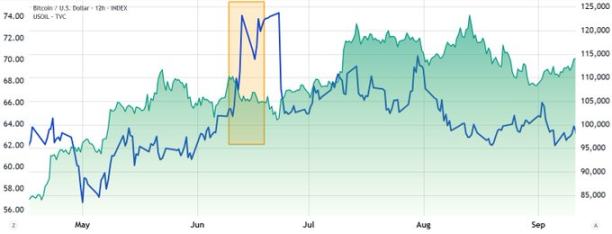
WTI Oil Price (Blue) vs. Bitcoin/USD (Green) —— May - August 2025. Source: TradingView
During the week starting June 11, 2025, WTI crude oil prices jumped 15% in a week. The trigger was international agencies discovering that Iran had refined uranium for nuclear warheads, followed by Israeli airstrikes on the region two days later. Bitcoin initially dropped 8%, falling from $110,300 to $101,000, but later recovered, gaining 10% within four weeks.
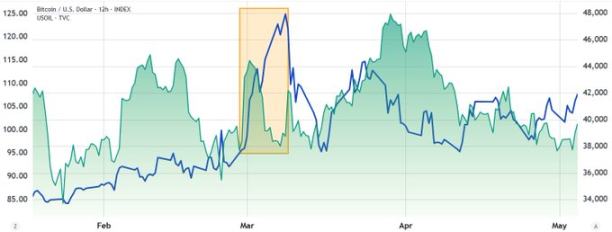
WTI Oil Price (Blue) vs. Bitcoin/USD (Green) —— March - May 2024. Source: TradingView
On March 27, 2023, due to a legal dispute that halted 450,000 barrels of daily crude exports from Kurdistan and unexpected OPEC+ production cuts, WTI oil prices surged 16% in eight days. Bitcoin rose 12% within two weeks but lost momentum, falling back to its original level around $28,000 in less than a month.
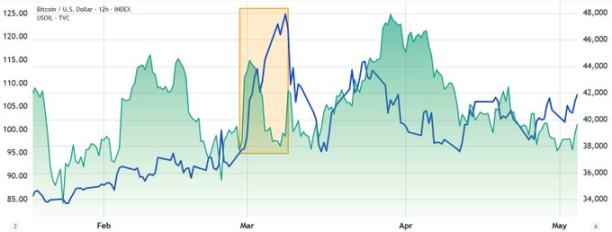
WTI Oil Price (Blue) vs. Bitcoin/USD (Green) —— February - April 2022. Source: TradingView
On February 28, 2022, following Russia's full-scale invasion of Ukraine and global sanctions on Russian oil exports, WTI oil prices skyrocketed 29% that week. Bitcoin initially followed, gaining 17% in the first two days, but gave up those gains by the weekend. However, it then surged 25% over the next three weeks, reaching $48,000.
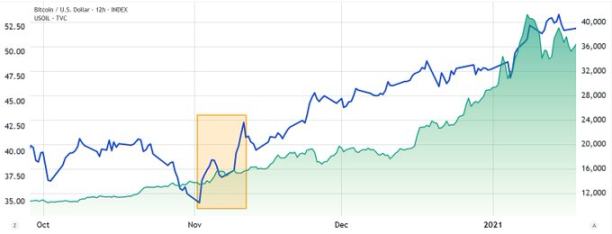
WTI Oil Price (Blue) vs. Bitcoin/USD (Green) —— October - December 2020. Source: TradingView
Over nine days starting November 2, 2020, driven by optimism about COVID-19 vaccines and an unexpected drop in US crude inventories, WTI oil prices rose 23%. Bitcoin also rallied, gaining 16% during those nine days. Subsequently, in less than a month, it skyrocketed 45% from $13,500.
If history repeats, Bitcoin could reach $79,200 by the end of March
In the previous four instances where WTI oil prices surged over 15% within 10 days, Bitcoin averaged a 20% gain in the following four weeks. These episodes occurred between November 2020 and June 2025, spanning much of the bear markets in 2022 and 2023. However, with only four data points, the sample size is too small to establish a strong correlation.
Recently, Bitcoin has primarily followed the lead of tech stocks, showing an 81% correlation with the Nasdaq 100 index. Therefore, if either Iran or the US shows signs of de-escalation, easing tensions, the stock market might rebound, and Bitcoin could likely follow suit.
Ultimately, whether Bitcoin can reach $79,200 by the end of March depends on how long the conflict with Iran persists. This target price is derived from a 20% increase from Bitcoin's price of $66,000 on February 28th, when the oil price rally began.

