



Writing: binji
Compilation: AididiaoJP, Foresight News
Civilizations can scale because humans can engage in implicit trust, while AI agents cannot.
The only way for them to build an agent society is through a truth ledger, which is the blockchain.
Money is always the first thing recorded on the ledger because it is the simplest form of truth that needs to be maintained:
- Who owns what
- Who paid whom.
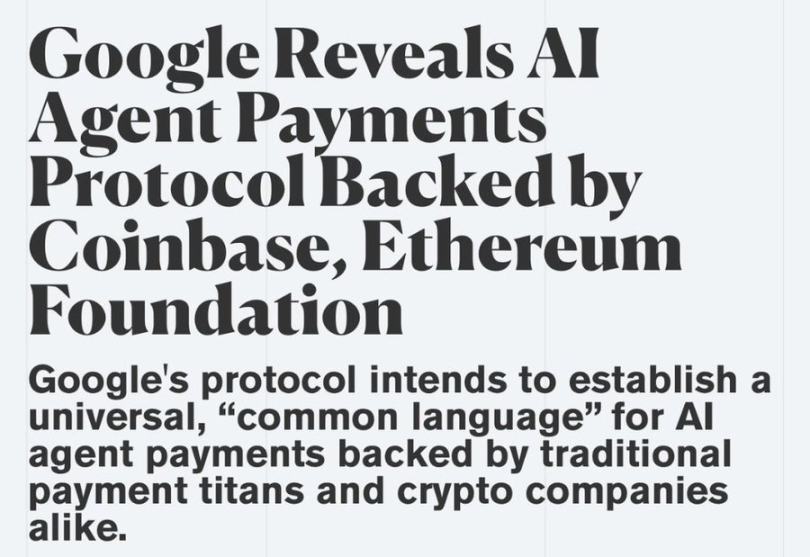
This is why the first AI standards, such as Google's AP2 and the X402 primitive supported by Coinbase and the Ethereum Foundation, start with payments.
The first step is that agents need a way to exchange value, but this is only the first step.
Humans rely on memory, reputation, and unspoken social cues to decide whom to trust, but agents lack these, so every action must be verified, every claim must be proven.
Standards like ERC-8004 begin to outline how this works: a shared registry where agents can anchor identity, reputation, and verification.
Its on-chain footprint is minimal, but sufficient for machines to discover each other and know who they are dealing with.
Once this is in place, the roadmap is clear:
- First, payments, because money is the clearest record.
- Second, identity and reputation, so that agents can transact with confidence.
- Then, coordination and contracts, enabling market operations and collective action among agents.
Why blockchain, and not just any distributed system?
Because blockchain is designed for adversarial environments, where:
- Every record is verifiable
- Every state transition is transparent
- Consensus emerges without participants needing to trust each other beforehand.
Databases can replicate data, permissioned systems can share logs, but these cannot prevent agents from lying, censoring, or rewriting history. Only blockchain provides credible neutrality, where no single participant holds the keys to the ledger, and no one can unilaterally make edits.
For us humans, this distinction might feel subtle because we carry implicit trust into most interactions. But for agents, it's existential, because when one machine interacts with another, it has no body language to read, no reputation to intuitively sense, no court system to rely on. Its entire confidence comes from verifiability, and blockchain is built precisely for that: a public, append-only memory bank where identities can be anchored and trust can be built.
The internet of agents will run on verifiable truth, and money is merely the opening act. The ultimate goal is to build an agent civilization where they communicate, trust, and share resources via the blockchain.
Now we have the hardware, we have the software, it's time to develop the trust component.

