



Zhu Yu, Jinshi Data
After a disappointing 2025, the U.S. labor market has shown surprising resilience at the start of the new year. The latest non-farm payroll report exceeded expectations, not only dispelling market fears of a rapid economic downturn but also prompting traders to reassess the Federal Reserve's policy path. Traders have fully priced in a Fed rate cut in July, having previously expected June.
Seasonally adjusted non-farm payrolls increased by 130,000 in January, significantly higher than the market consensus of 70,000, marking the largest increase since April 2025. The U.S. January unemployment rate came in at 4.3%, slightly below the market expectation of 4.4%, reaching a new low since August 2025.
November's non-farm payroll increase was revised down from 56,000 to 41,000; December's was revised down from 50,000 to 48,000. After revisions, the combined job gains for November and December were 17,000 lower than previously reported.
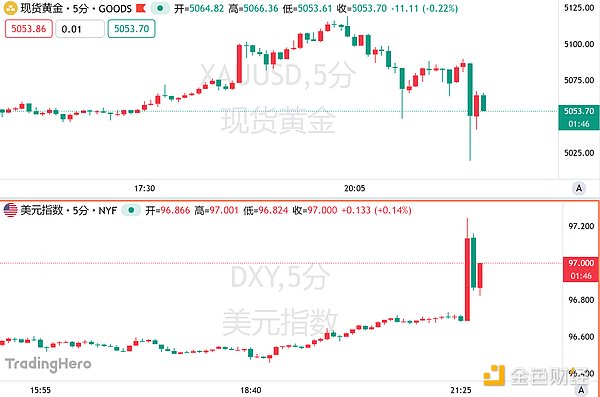
Following the release of the non-farm data, spot gold plunged nearly $40 in the short term, and U.S. Treasury yields rose across the board after the data. Non-U.S. currencies generally fell sharply, with EUR/USD dropping over 60 pips; GBP/USD falling over 70 pips; and USD/JPY surging nearly 100 pips.
Structural improvements in the job market are also evident. As a key indicator of potential purchasing power, average hourly earnings rose 0.4% month-over-month, stronger than expected; the average workweek also rebounded to 34.3 hours. Additionally, the labor force participation rate edged up from 62.4% to 62.5%, and even the long-weak manufacturing sector finally "turned a profit," adding 5,000 jobs in January.
Bloomberg Intelligence strategists pointed out that the dual growth in wages and hours is more critical than a simple increase in job numbers, as it means household spending power is sustained, further increasing the likelihood of a soft landing for the economy.
"Beating" Wall Street
The January job growth figure beat nearly all forecasts in Bloomberg's survey, with only Citigroup and Santander's earlier predictions (135,000 and 130,000 increases, respectively) coming close to the actual result. Morgan Stanley economist Michael Gapen noted that this report is "the real deal," and the average hourly earnings data indicates the quality of the new jobs is high.
Breaking down by industry, the healthcare sector continued to lead, adding 82,000 jobs in a single month, serving as the undeniable mainstay. The construction sector also performed well, adding 33,000 jobs.
Particularly noteworthy is the manufacturing sector's counter-trend recovery. The sector added 5,000 jobs in January, its first positive growth since September 2024, completely overturning the market's previous pessimistic forecast of a "7,000-job loss." While it remains to be seen if this growth can form a long-term trend, it is undoubtedly a positive signal after a period of significant weakness for manufacturing.
However, not all sectors are expanding. Affected by the ongoing "Department of Government Efficiency" (DOGE) effect, federal government employment fell sharply by 34,000, showing the direct impact of fiscal tightening policies on public sector jobs.
CPI Could Bring a "Hawkish" Surprise
Despite the strong January data and an upward revision of 17,000 jobs for November and December last year, taking a longer-term view, the foundation of the U.S. job market remains fragile.
First, the annual data is not optimistic. Total job growth for all of 2025 was only 181,000. Excluding the special years of the COVID-19 pandemic and the "Great Recession," this is the worst annual performance since 2003 (when the U.S. was recovering from the dot-com bubble burst).
Second, large-scale benchmark revisions revealed previous data was overstated. After seasonal adjustment, historical data was significantly revised down by 898,000 jobs (862,000 unadjusted). The average monthly job gain in the U.S. for 2025 was only 15,000, a level that can be described as "bleak" compared to previous years.
This means that over the past year, there actually haven't been that many new consumers created to drive economic spending. This revised data also largely explains why, despite seemingly "hot" job numbers, consumer confidence indices have consistently revealed anxiety about the job market.
Kay Haigh, an analyst at Goldman Sachs Asset Management, said there are some initial signs of the labor market re-tightening, but it still has a way to go before being fully tight. Given the economy's continued outperformance, the FOMC's focus will shift to the inflation situation. "We still believe the Fed has room for two more rate cuts this year; however, an unexpectedly high CPI reading on Friday could tilt the Fed in a more hawkish direction."

