



By: JIN10 DATA
Gold experienced one of its most dramatic price drops in years on Friday and Monday. The market's rationale was that Kevin Warsh, President Trump's nominee for Federal Reserve chair, might pursue orthodox policies, diminishing the appeal of precious metals as a hedge against currency devaluation, and this selling wave has spread to other metals.
However, analysis points out that a more plausible idea might be that the vagaries of the options market are disrupting gold's role as a barometer for geopolitical conflict.
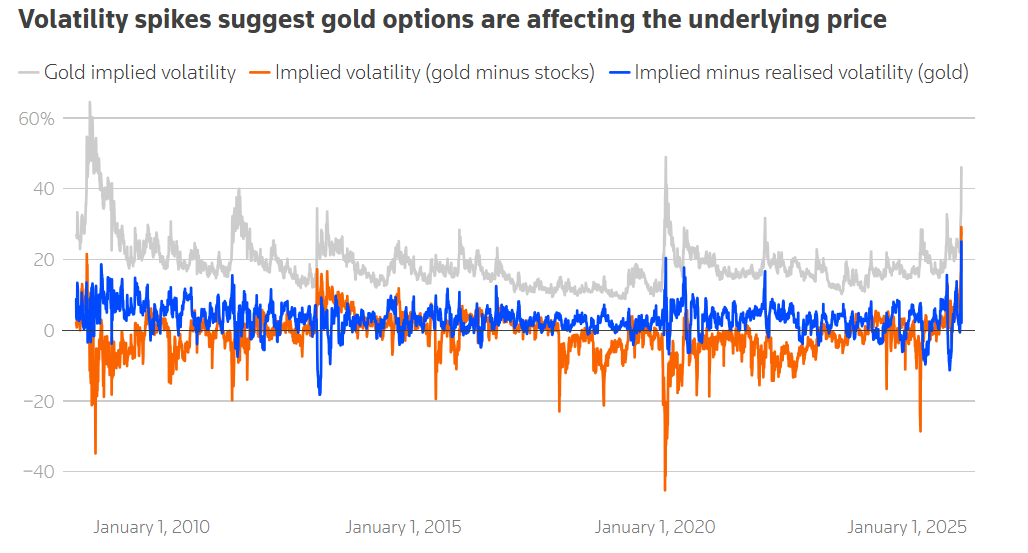
One clue lies in the Cboe Gold Volatility Index, which uses options on the SPDR Gold Trust (GLD) ETF to gauge the level of gold price volatility expected over the next 30 days. This index recently closed above 44. Such levels have only been seen during the 2008 global financial crisis and the 2020 COVID-19 crash.
In theory, gold options should track, not influence, the gold price. However, over the past year, investors have purchased massive amounts of GLD "call" options, meaning they were betting on price increases. They also bet on a silver surge through the iShares Silver Trust (SLV) fund. Their counterparties, the banks, were thus exposed to the risk of price declines.
Financial institutions hedge by buying metal futures or ETF shares. Once this happens, it only takes a relatively mild shock to snowball into a massive sell-off, as options traders rush to adjust positions and banks become sellers.
Analysis notes that this feedback loop resembles the notorious "Gamma squeeze" triggered in 2021 by Reddit retail investors buying GameStop stock. It also echoes, in another form, the "Volmageddon" that caused the S&P 500 to plummet in 2018.
The U.S. stock market is already accustomed to these fund flows. According to Cboe data, the daily notional trading volume of U.S. blue-chip stock options has surged from about $0.5 trillion in 2020 to nearly $3.5 trillion in 2025.
Strong evidence suggests the same is happening with precious metals, whose options trading volume has also increased. The level of 44 reached by the Cboe Gold Volatility Index last week set a new record compared to both gold's actual volatility and the implied volatility of the S&P 500. Furthermore, implied volatility was rising before the actual gold price crash, without the underlying asset losses typically accompanying such moves. All of this points to frenzied "call" option buying fueling the fire.
Among the lessons for gold buyers from the options-influenced stock market, the main one is: sell-offs driven by such market distortions often don't last long.
In fact, analysis shows that when gold's implied volatility rises above 40%, the gold price tends to increase by an average of 10% three months later. Of course, given how much gold prices have already risen, it might not be so smooth this time.

